IREN's Mirantis Acquisition: The Missing Piece and the Earnings-Call Timing

Source: IREN press release (May 5, 2026)
On May 5, IREN announced the acquisition of Mirantis. Deal size: $625 million, 100% paid in IREN ordinary shares, zero cash out. The announcement landed two days before the Q3 FY26 earnings call. Not an ordinary news drop.
IREN’s Weakness: The Software Layer on Top of GPUs
IREN’s business runs on two tracks: Bitcoin mining and AI Cloud (GPU rental).
The company has long pitched its vertical integration as the moat. Power, then land, then the data center, then the GPUs. Buy land near power plants, build the data center on it, fill it with NVIDIA GPUs, and rent them out to customers.
The missing piece sat one layer higher: the software stack running on top of those GPUs.
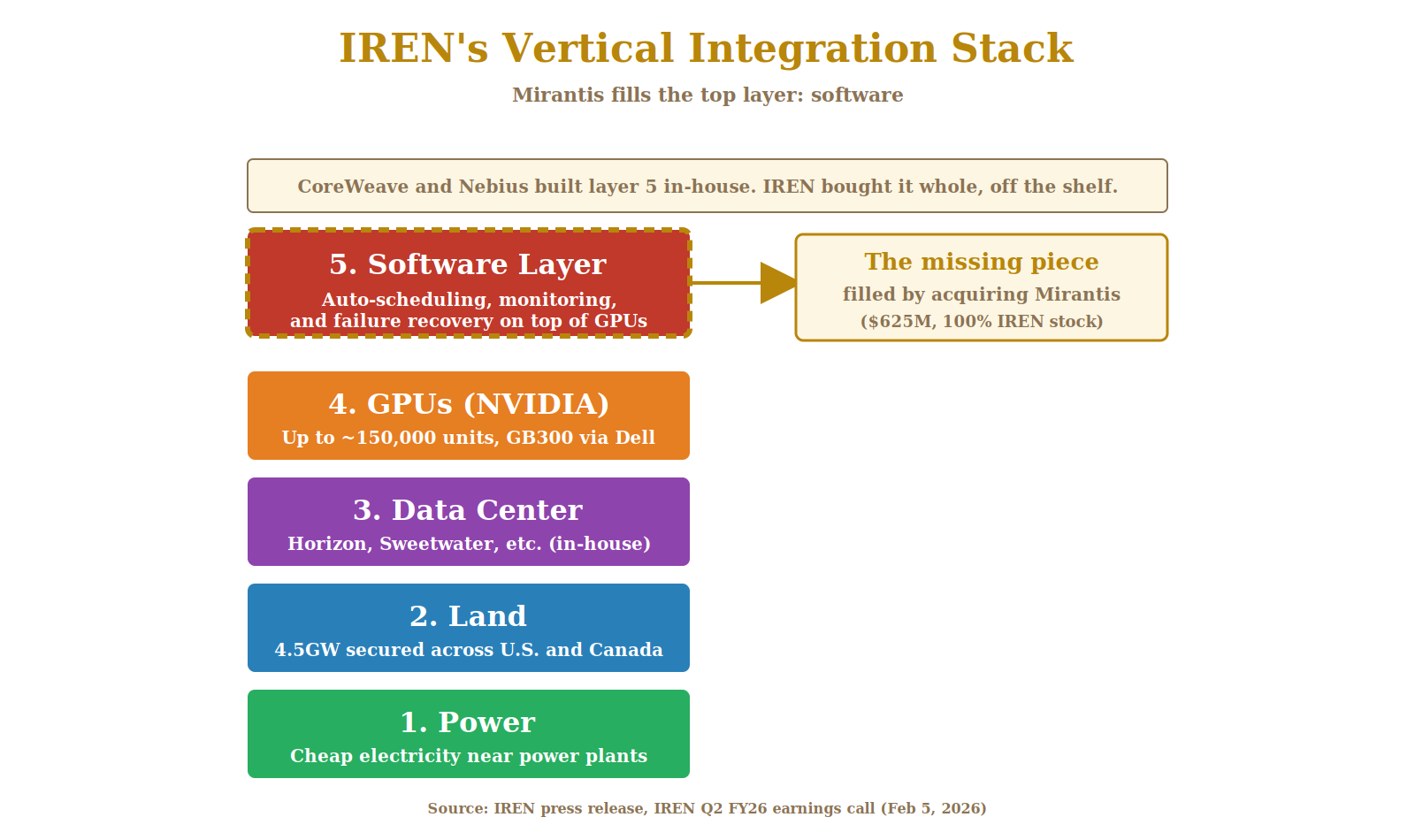
IREN’s pitch was a four-layer vertical stack. The fifth layer, software, was the one missing piece. (Backup keywords: IREN vertical integration software layer Mirantis)
GPU rental is not a simple rental. When a customer says “I need 50 GPUs to train a model,” IREN has to decide which 50 out of tens of thousands to assign. If one of those 50 fails, the system swaps in another automatically. When training ends, those GPUs go back to the pool. When the customer asks how the job is going, the system shows it on a dashboard.
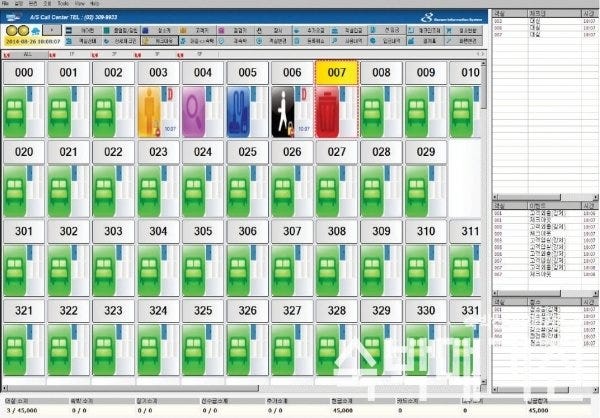
A hotel-management dashboard for tens of thousands of rooms: assign rooms to guests, swap when something breaks, schedule housekeeping after checkout. (Backup keywords: hotel management system room status dashboard)
All of that automation lives in the software layer. Think of it like a hotel manager who decides which of the tens of thousands of rooms each guest gets, moves them when something breaks, and arranges housekeeping after checkout. All without human intervention.
A service like Netflix runs on thousands of servers, which is exactly the kind of orchestration Kubernetes was built for. (Backup keywords: Netflix logo streaming service infrastructure scale)
Full-stack AI cloud players like CoreWeave and Nebius built this layer themselves. For IREN, this was the weakest link.
IREN Knew About This
IREN was not blind to the gap. On the Q2 FY26 earnings call (Feb 5, 2026), Co-CEO Daniel Roberts admitted the company has internal software capability but has been deliberately downplaying it. Then he added:
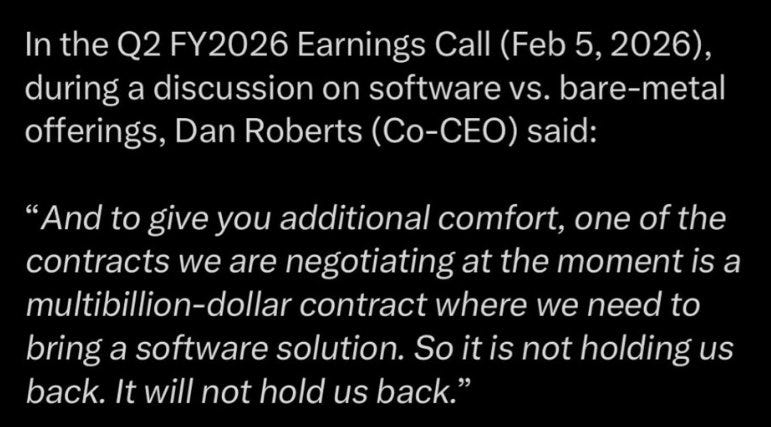
Source: IREN Q2 FY26 earnings call transcript (Feb 5, 2026)
Three months later, the Mirantis acquisition was announced. Instead of spending years building it internally, IREN chose to buy the whole thing from outside. Read this as preparation specifically for landing the multibillion-dollar contract Roberts hinted at.
The Four Assets Mirantis Brings
Mirantis was founded in 1999 in Campbell, California. Its core business is building tools that manage hundreds or thousands of servers as if they were one. The industry term is Kubernetes.
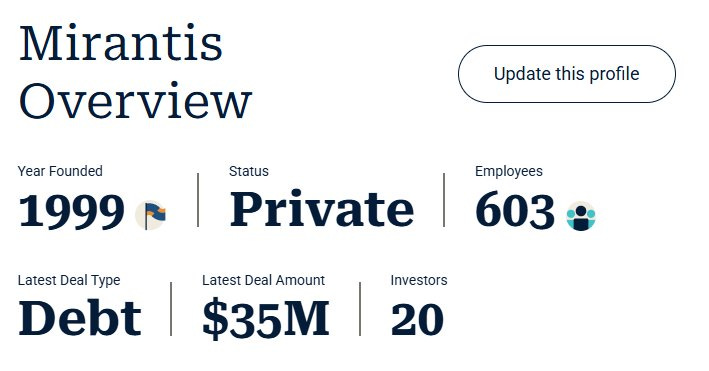
Source: PitchBook Mirantis profile (founded 1999, private, 603 employees)
Why does Kubernetes exist? A service like Netflix cannot run on a single server. One server’s CPU and memory cannot handle simultaneous requests at scale. If one server dies, the whole service goes down. And if users are spread across the globe, latency to the nearest server matters. The fix is a system that automatically distributes work across thousands of servers, spins up replacements when one dies, and adds capacity when traffic spikes. That system is Kubernetes. Mirantis has been building it for over a quarter-century.
The acquisition brings IREN four assets at once.
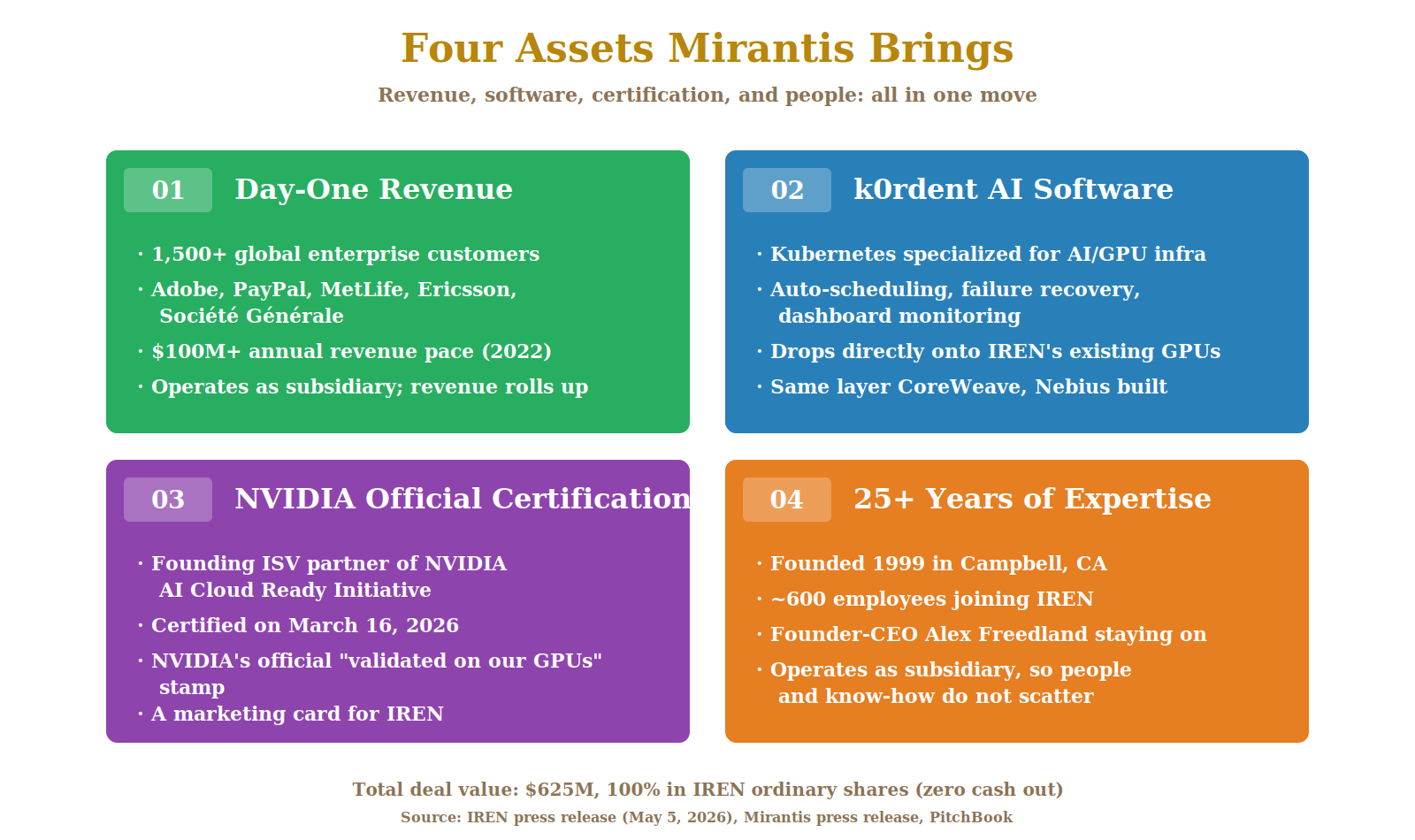
Mirantis brings revenue, k0rdent AI software, NVIDIA certification, and a 600-person team. (Backup keywords: Mirantis 4 assets revenue software NVIDIA certification team)
A revenue-generating business, day one. Mirantis serves over 1,500 global enterprise customers. Adobe, PayPal, MetLife, Ericsson, and Société Générale are among the marquee names. In a 2022 TechCrunch interview, the company indicated annual revenue was running above $100 million. Mirantis will continue as a standalone subsidiary post-close, so those 1,500 customers stay on the Mirantis brand and the revenue rolls straight into IREN’s consolidated statements. This is not a cost center being acquired. It is revenue walking in the door.
Software that drops directly onto IREN’s GPUs. Mirantis’s flagship product, k0rdent AI, takes Kubernetes and tailors it for AI and GPU infrastructure. When a training or inference job arrives, k0rdent decides which GPU to assign, swaps in another if one fails, and surfaces progress on a dashboard. The appeal for IREN is that the software drops directly on top of the GPUs already deployed. The land is there. The data centers are there. The people are there. Just bolt the layer on top. IREN is essentially buying, off the shelf, the same software stack CoreWeave and Nebius spent years building.
Official certification in the NVIDIA ecosystem. Mirantis is a founding ISV (Independent Software Vendor) partner in NVIDIA’s AI Cloud Ready Initiative. The program is essentially NVIDIA stamping a vendor as “validated to run on our GPUs.” Mirantis received the certification on March 16, 2026. Once the deal closes, IREN inherits the badge and can pitch itself as an “NVIDIA-certified full-stack AI cloud provider.”
A quarter-century of operational expertise, and the people who built it. Running large-scale infrastructure still involves significant work that humans do by hand. IREN gets roughly 600 employees who have spent more than 25 years doing exactly this. Because Mirantis stays as a subsidiary and founder-CEO Alex Freedland is staying on, the people and the institutional knowledge do not scatter.
In short, the Mirantis acquisition brings IREN revenue, GPU-layer software, NVIDIA certification, and an operational team in a single move.
Why It Was Paid Entirely in Stock
The deal is structured as 100% stock. At IREN’s May 4 closing market cap of approximately $16.4 billion, issuing $625 million of new shares translates to roughly 4% dilution.
Dilution is a real cost. But the offsetting effects matter too.
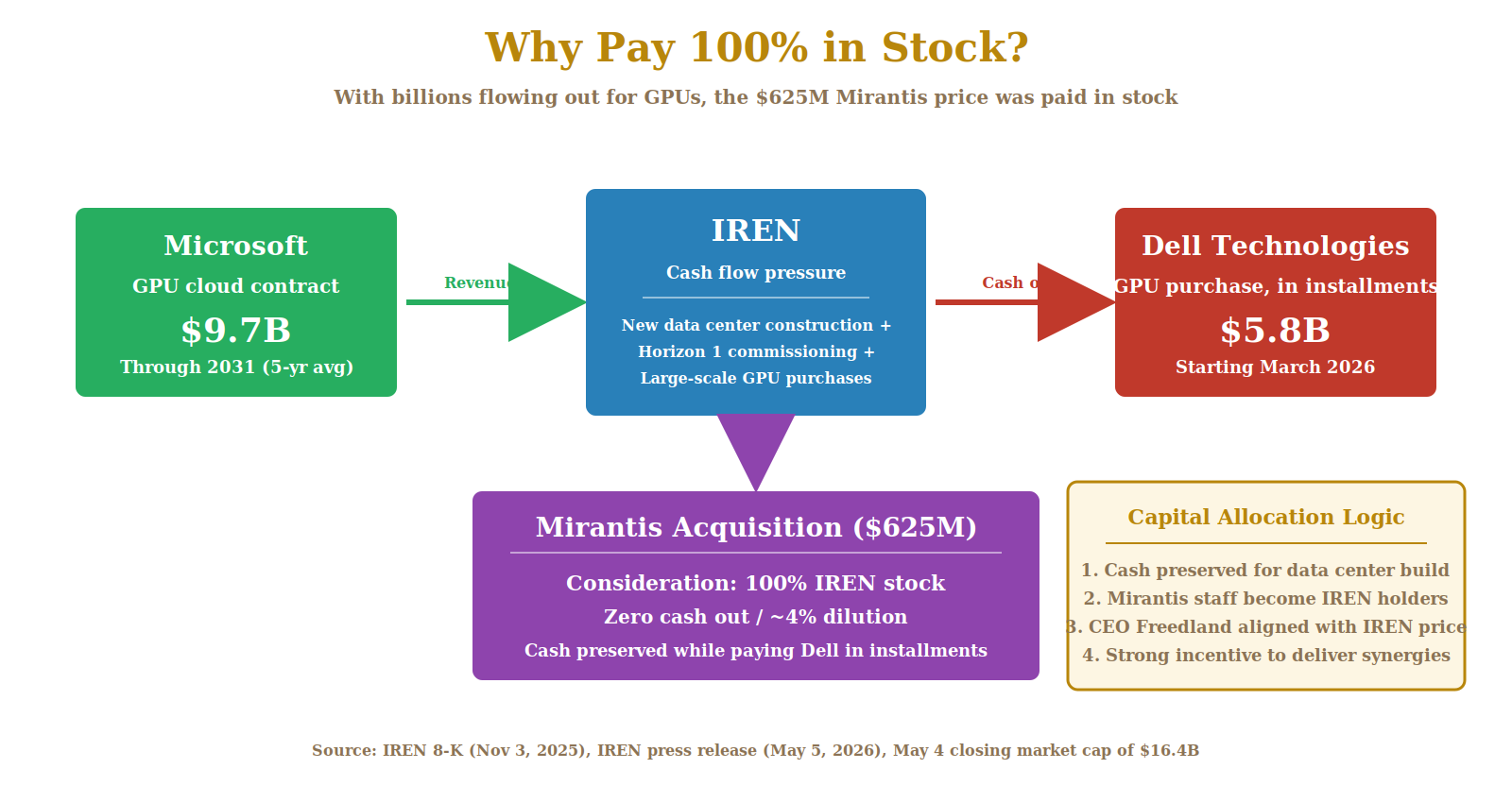
Microsoft revenue flows in while Dell payments flow out. The $625M Mirantis price was paid in stock to preserve cash. (Backup keywords: IREN Microsoft Dell Mirantis capital flow stock payment)
Start with cash preservation. After landing the Microsoft GPU cloud deal in November (worth $9.7 billion through 2031), IREN owes Dell Technologies $5.8 billion for the GPUs themselves, paid in installments. With billions in cash flowing out the door, paying $625 million in stock instead of cash is a defensible capital allocation choice.
Second, because the consideration is entirely in stock, every Mirantis shareholder, including employees, becomes an IREN shareholder. That keeps people from walking out the door and creates a strong incentive to make the integration deliver synergies. Freedland himself is now betting on IREN’s share price.
4% Dilution on Top of an Already-Heavy Stack
That said, this 4% piles on top of dilution pressure that has been accumulating for over a year.
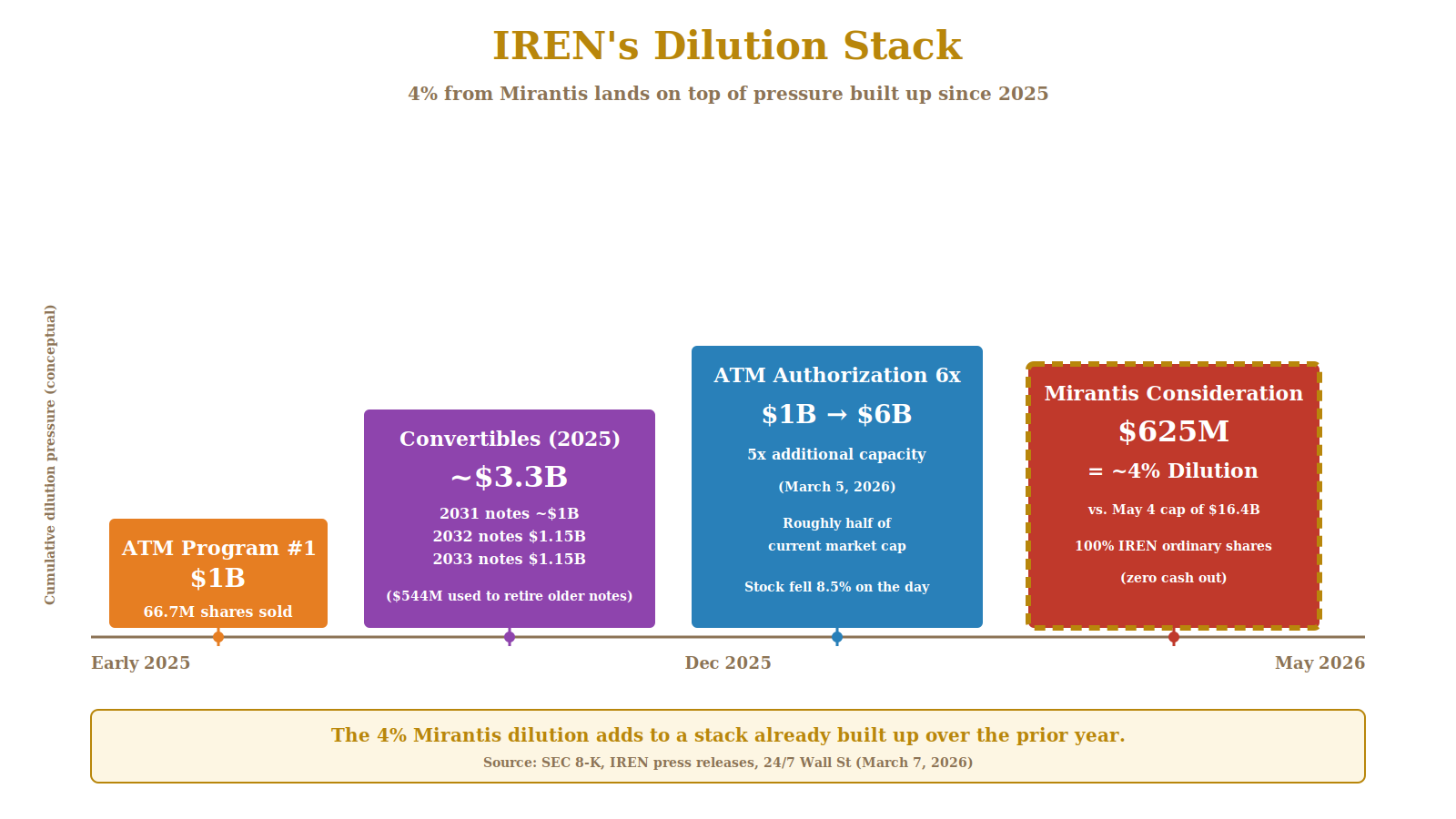
Mirantis 4% dilution stacks on top of $1B ATM, $3.3B convertibles, and a 6x ATM authorization expansion. (Backup keywords: IREN dilution stack ATM convertible notes 2025 2026)
Through 2025, IREN sold 66.7 million shares directly into the market for $1 billion under its first ATM program, and issued roughly $3.3 billion of convertible notes (around $500 million of which was used to retire older notes). On top of that, the company expanded its ATM issuance authorization 6x, from $1 billion to $6 billion, in March 2026.
A second concern: Mirantis is private, so revenue is not externally verifiable, which makes judging whether $625 million is the right price difficult. Using the 2022 interview reference of “$100 million-plus annualized revenue” as a baseline, the implied multiple is in the 5x to 6x revenue range. By AI infrastructure comparable standards, that is not expensive.
Why Two Days Before the Earnings Call
The timing of the announcement is not accidental either. Going into the May 7 earnings call, the market was focused on three questions: Did AI Cloud revenue track to guidance? When does Horizon 1 come online? Are there any new hyperscaler contracts in the pipeline?
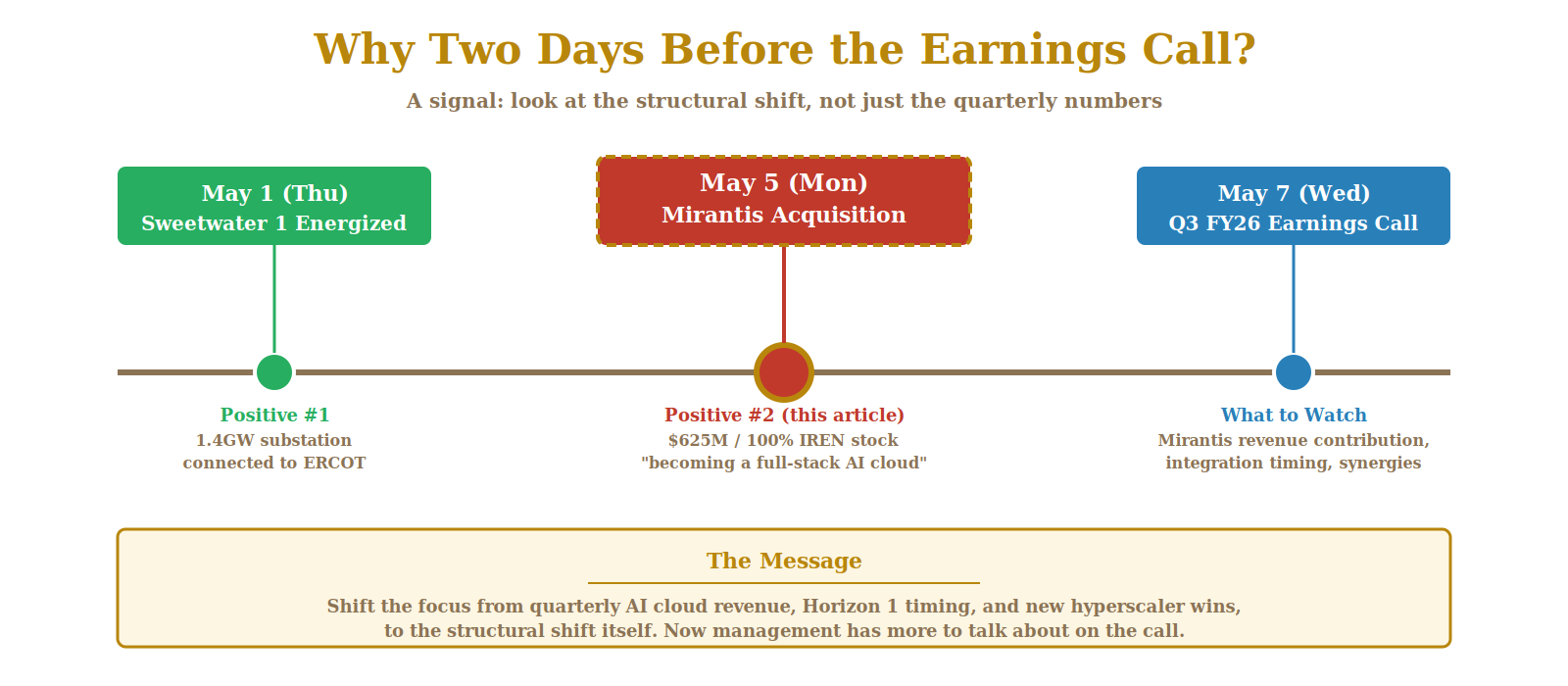
Sweetwater 1 energization on May 1, Mirantis acquisition on May 5, Q3 earnings on May 7. (Backup keywords: IREN earnings May 7 timeline Sweetwater Mirantis)
As argued in our prior analysis (Korean), this is a quarter where IREN was unlikely to fully meet expectations on those three points. Dropping the Mirantis card two days before earnings reads as a deliberate signal: do not focus only on the quarterly numbers, look at the structural shift in the business.
The signal: “we are not just a GPU rental company anymore, we are becoming a full-stack AI cloud company.” Management now has more to discuss on the call.
The deal still requires regulatory approval and will take a few months to close. If integration goes well, IREN could genuinely become a full-stack operator. Plenty of acquisitions, however, fail to deliver promised synergies. The next thing to watch: how IREN frames Mirantis’s revenue contribution, integration timeline, and synergy targets on the May 7 earnings call.
TL;DR
IREN is acquiring Mirantis for $625 million in IREN ordinary shares. The deal absorbs roughly 4% dilution to fill the missing piece in IREN’s stack: the software layer that runs on top of GPUs.
Mirantis is a quarter-century-old Kubernetes veteran. The acquisition delivers four assets at once: 1,500 enterprise customers and revenue, the k0rdent AI software that drops onto IREN’s existing GPUs, founding ISV status in NVIDIA’s AI Cloud Ready Initiative, and approximately 600 operational staff.
The timing (two days before the May 7 earnings call) reads as a signal that management wants the structural shift, not the quarterly numbers, to be the headline.
References
IREN press release (May 5, 2026): IREN Announces Acquisition of Mirantis to Strengthen AI Cloud Delivery Capabilities
IREN SEC 8-K (Nov 3, 2025): Microsoft Agreement and Dell Purchase Agreement
Mirantis press release (Mar 16, 2026): Mirantis Joins NVIDIA AI Cloud Ready Initiative as Founding ISV Partner
IREN Q2 FY26 earnings call transcript (Feb 5, 2026)
24/7 Wall St (Mar 7, 2026): IREN’s $6 Billion Stock Offering
Prior analysis (Korean): Why IREN’s Q3 FY26 Revenue Could Disappoint - Part 1
I’m not an expert. I’m learning alongside you, and writing about what I find.