
Oklahoma Is Walling Off Data Centers. That Makes IREN's Already-Powered Land Worth More.

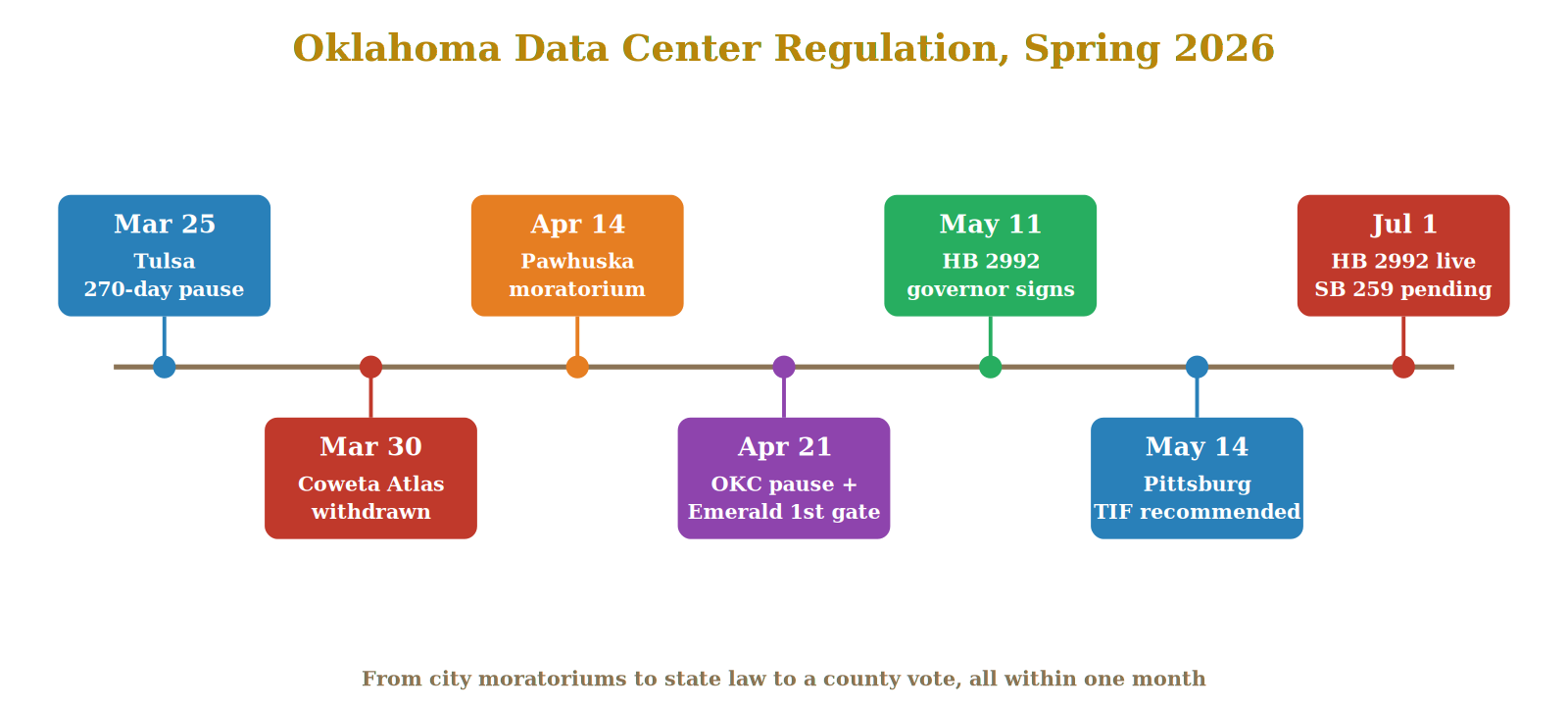
On April 21, a committee in Pittsburg County, Oklahoma voted unanimously. It was the moment IREN’s data center campus, Project Emerald, cleared its first administrative gate.
The same day, in the same state, the Oklahoma City Council also voted unanimously. The direction was the opposite. The city would stop accepting new data center applications through December 31.
In a single day, Oklahoma opened the door to data centers and shut it at the same time.
What happened in Oklahoma in a single week
Project Emerald is the code name for the data center campus (a large complex of servers and power equipment) that IREN is building on 2,000 acres just south of Kiowa, a rural town in Oklahoma. The two-phase project is estimated at roughly $50 billion.
Oklahoma City’s decision was only the start. Mayor David Holt explained the pause this way. Even when a national model seems to settle into place, it soon collapses. Things move so fast that hitting pause was the right call.

Source: KGOU
The Tulsa City Council voted unanimously in late March for a pause of about nine months, 270 days. It halts new data center construction permits through year end.

Source: KJRH
Pawhuska, north of Tulsa, voted unanimously on April 14 to halt data center review through the end of December.
Project Atlas, planned in Coweta next to Tulsa, was withdrawn by its developer. San Francisco-based Beale Infrastructure had planned a data center on 270 acres. During the process it emerged that city officials had signed a non-disclosure agreement (NDA) with the company, and as resident pushback grew, the company pulled its application on March 30.

Source: Coweta Project Atlas withdrawal coverage
In short, within a single week in Oklahoma, moratoriums (temporary halts on new permits) and a voluntary withdrawal piled up at once.
A law the governor signed himself
The wave moved up to the state level a few days later.
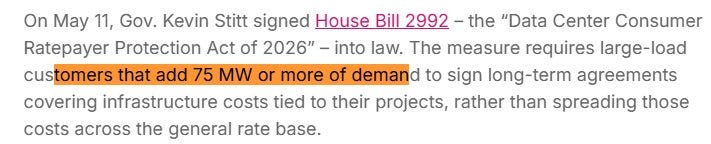
On May 11, Oklahoma Governor Kevin Stitt signed the Data Center Consumer Ratepayer Protection Act (HB 2992). It applies to new facilities that draw 75 megawatts (MW) or more of power. Project Emerald, at 1.2 gigawatts (GW), or 1,200 megawatts, is more than 16 times that threshold. It clearly qualifies.
Source: HB 2992 coverage
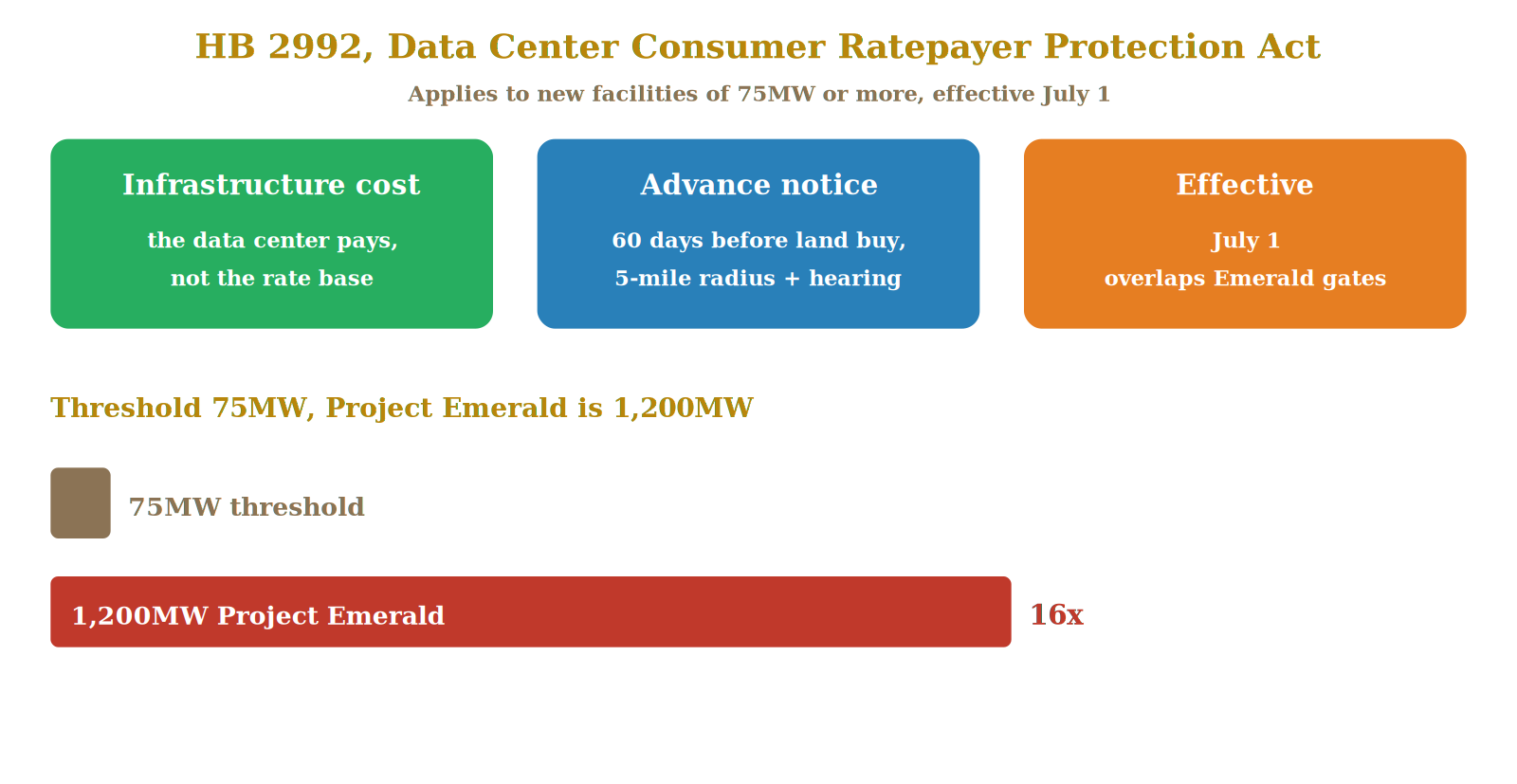
The law has three core parts.
First, the cost of new wires, substations, and generation that a data center requires must be covered by that data center under a long-term contract. It closes the path of slipping those costs onto ordinary households’ power bills.
Second, facilities of 75 megawatts or more must give notice 60 days before buying land. The notice goes to the state regulator (the Corporation Commission), the relevant county commissioners, and every resident within five miles (about eight kilometers) of the site. It must also run in a local newspaper for two consecutive weeks, and a public meeting must be held. It blocks the pattern of a deal closing before residents even know.

Source: Oklahoma Senate, HB 2992
Third, the effective date is July 1. That lines up almost exactly with when Project Emerald aims to clear its next gates.
One thing is worth noting. Stitt is known as a business-friendly figure, and Oklahoma has actively courted data centers. A law like this coming from that governor and that state reads as a signal that resident frustration has grown sharply.
The law does not impose a large immediate cost on IREN. It does affect the timeline. The local utility, PSO (Public Service Company of Oklahoma), has to design separate terms for large customers (a large load tariff, a dedicated rate for major power users) and win regulatory approval, and new steps like the 60-day notice get inserted.
Time, not cost, is the variable.
The water is tied up too
Power is not the only problem. Data centers use a lot of water to cool server heat. The cooling-water source floated for Project Emerald is McAlester, a city north of Kiowa.
The McAlester City Council once authorized negotiations to sell 6 million gallons of raw water (untreated water) for data center cooling. The buyer was not IREN but an intermediary, Black Mountain Energy Storage, which said it would use the water to cool IREN’s facilities.
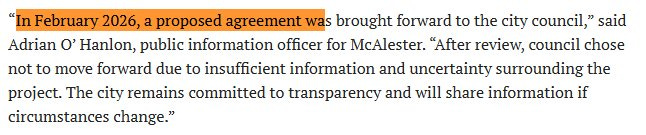
Then in February 2026, the council stopped it. The city’s public information officer explained it this way. A proposed agreement came forward, but after review the council decided not to proceed, citing insufficient information and uncertainty around the project.
Source: McAlester city public information
Two things stand out. One is that the city did not say no sale. It said it could not decide with the current information. The door to the negotiating table is still open. The other is that the act of refusing once gives the city leverage in the next round of talks. On price or terms, the city now has grounds to push harder.
There is one more state bill. SB 259. It started as a law to meter groundwater use, but a clause added on April 8 takes direct aim at data centers. Data centers that use groundwater for cooling may only use a closed-loop method that recirculates the water they receive. In effect, it forces a cut in water use.

Source: Oklahoma Farm Bureau, SB 259
The bill passed the House in early May, went back through the Senate for re-approval, and now sits on the governor’s desk. Big tech lobby groups like NetChoice have even sent Stitt a letter requesting a veto. That tells you the industry knows the weight of this law.
The outcome is not certain. Stitt vetoed a nearly identical groundwater metering bill from the same lawmaker in 2024, calling it government overreach. SB 259 could still go either way, signed or vetoed.
The data center water question has now moved past local complaints into a state-law variable.
Where Project Emerald stands now
Now back to IREN.

Source: NonDoc
Looking at Project Emerald alone, the odds of a delay are higher than on April 21. The Kiowa High School public hearing has not been held yet, there is still no McAlester water contract, and the project now falls under the state law passed in May.
Still, it is not frozen. On May 14, the Pittsburg County review committee formally recommended approval of the tax incentive district (TIF, a mechanism that returns the added tax revenue from development to infrastructure costs) tied to the project. The next step, a final county commissioners vote, remains.
IREN’s execution, which cleared the first gate unanimously on April 21, is intact. But the gates after it have gotten harder.
The path is not blocked. It has gotten longer.
From IREN’s side, the picture flips
Step back, though, and a different picture appears.
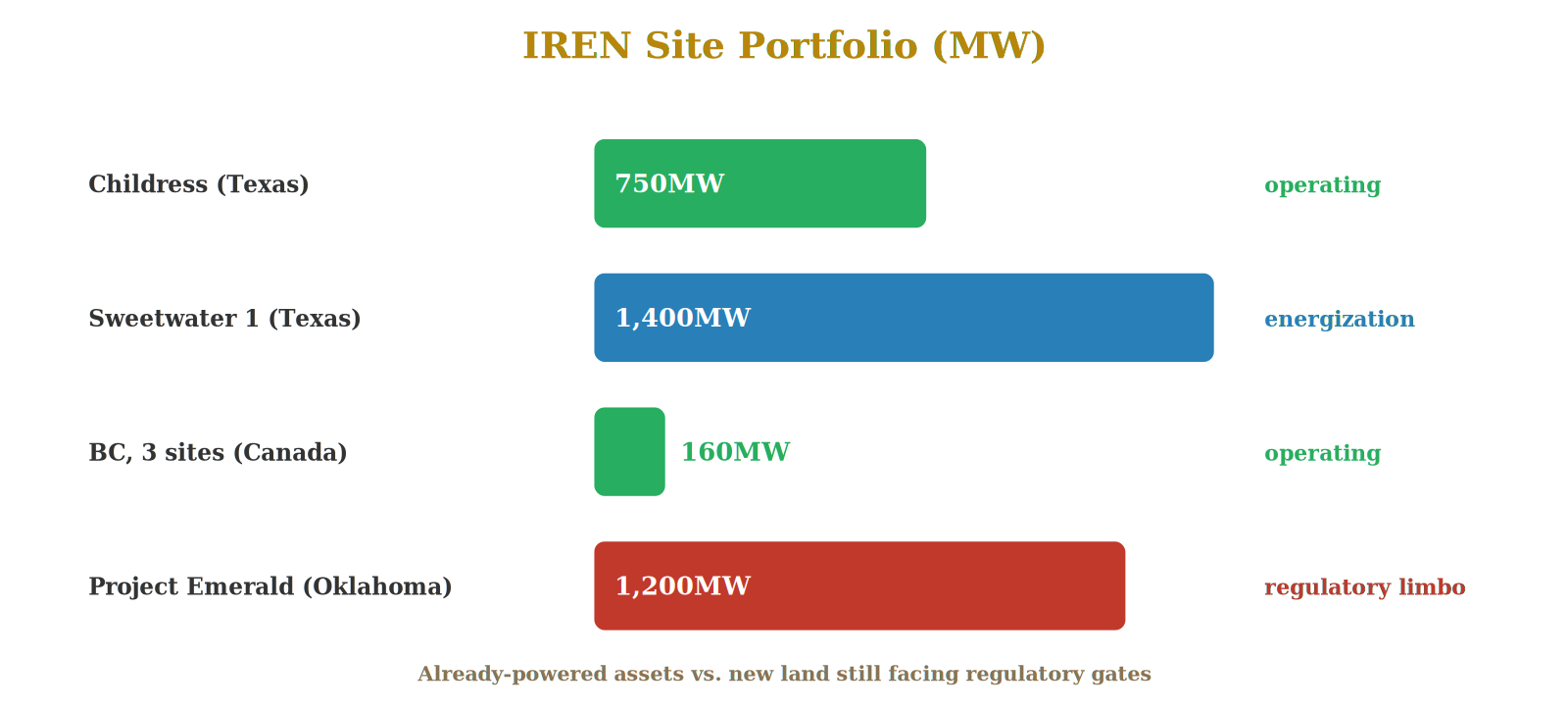
The land IREN already holds is not small. Childress in Texas runs at 750 megawatts and is already operating, the company’s largest campus.
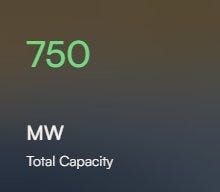
Source: IREN (Childress 750MW)
Sweetwater 1 in Texas, at 1.4 gigawatts, entered energization (the stage where the substation goes live) in April. Server (GPU) installation is still underway, so it is not yet fully operational.

Source: IREN (Sweetwater 1)
The three sites in British Columbia, Canada (Canal Flats 30MW, Mackenzie 80MW, Prince George 50MW) add up to 160 megawatts.

Source: DCD (BC sites)
One trend is converging across the US data center market. The road for a new site to reach operation keeps getting longer.
New application freezes, tax break rollbacks, mandatory separate tariffs, water use limits, council opposition. These obstacles are stacking up at once. Oklahoma City revised its moratorium in mid-May, but only exempted smaller facilities under 75 megawatts while keeping the freeze on hyperscale (very large) facilities. The El Paso City Council in Texas stopped recruiting large data centers altogether in late May.
The read is simple. The value of land that is already powered and running goes up.
A past tweet from IREN co-CEO Daniel Roberts lands harder right now. He wrote, “Time to compute is everything.” The time it takes to reach compute is what matters most.

Source: Daniel Roberts (@danroberts0101), X
He added that the physical infrastructure advantage comes first, and that everything else compounds from there.

Source: Daniel Roberts, X
It is no longer holding land that is becoming the scarce asset. It is land where electricity already flows.
If Project Emerald slips or pauses for a step, that is disappointing news in the short term. But the same pressure applies to rivals’ new sites just the same. The relative value of sites already running can actually rise.
The more the road for new sites is blocked, the more valuable already-powered land becomes.
What to watch from here
Project Emerald is paused for now. It will start moving again once a hearing is scheduled.
What to watch in the meantime is clear. When the Kiowa High School hearing notice comes out, whether the McAlester council takes up the water contract again, whether Stitt signs or vetoes SB 259, and how the Pittsburg County commissioners’ final tax incentive district vote lands. Texas also has a hearing coming in July, so that result carries on too.
For IREN, the structure is this. The more the road to operation is blocked for new sites, the better the position of land, power, and fiber that is already running. There will come a point where the market starts to price this in.
TL;DR
* On April 21, the same day Project Emerald cleared its first county gate unanimously, Oklahoma City halted new data center applications. Over the following week, the Tulsa and Pawhuska moratoriums, Coweta’s Project Atlas withdrawal, Governor Stitt signing the ratepayer protection law (HB 2992), the McAlester water rejection, and SB 259 all made the regulatory environment heavier at once.
* At 1.2GW, Project Emerald is more than 16 times the 75MW threshold, so it falls directly under the new state law, and the McAlester cooling-water contract is still stuck, making the next gates tougher than in April.
* But the same pressure applies equally to rivals’ new sites, so the relative value of the land IREN already holds at Childress (operating) and Sweetwater 1 (energization stage) is structurally rising.
References
NonDoc, “Pittsburg County committee endorses deal tied to 2,000-acre, $50 billion data center site” (2026-05-14)
KGOU, “Oklahoma City leaders approve data center moratorium” (2026-04-22)
KJRH, “Tulsa City Councilors pump brakes on new centers for 2026” (2026-03-26)
KTUL / Tulsa Flyer, “Developer pulls out of Project Atlas data center” (2026-03-30)
Oklahoma Energy Today, “Bill protects Oklahoma consumers” (HB 2992, 2026-05-11)
Oklahoma Senate, “Senate Passes Data Center Ratepayer Protection Act” (2026-04-28)
McAlester (city public information officer) statement (2026-02)
Oklahoma Farm Bureau / KOSU, SB 259 (2026-04 to 05)
NetChoice, “Veto Request Letter to Gov. Stitt on SB 259” (2026-05)
HPPR, “Stitt vetoes Oklahoma groundwater metering bill” (HB 3194, 2024-05)
IREN / DCD, Childress, Sweetwater and BC capacity data
Daniel Roberts (@danroberts0101), X
I’m not an expert. I’m learning alongside you, and writing about what I find.